How Many Solar Panels Do You Need to Power Your House?
The 5 factors that determine your panel count
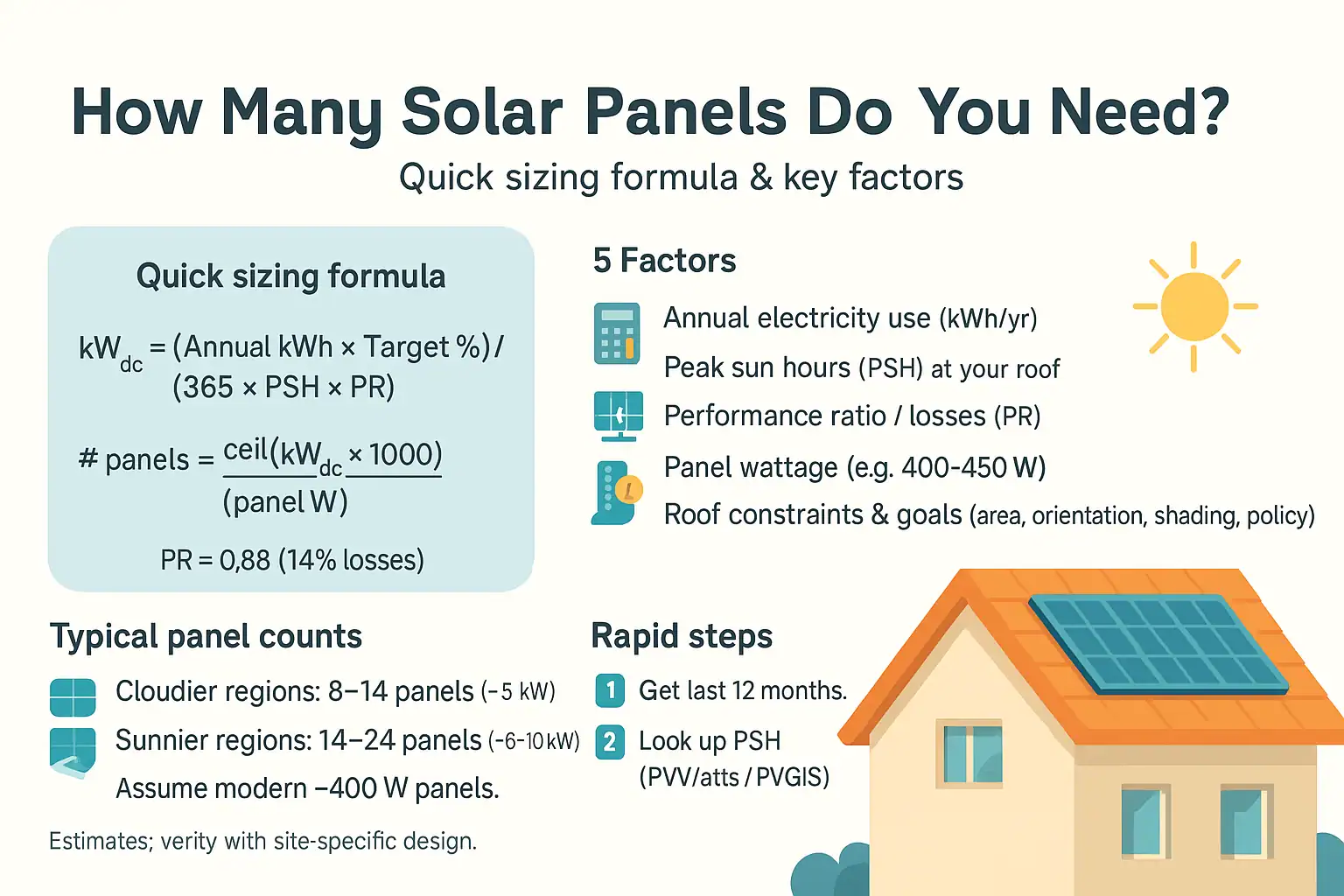
- Your annual electricity use (kWh). Pull the last 12 months from your utility bill or smart meter app. This is the single most important input.
- Your solar resource (aka peak sun hours) at your roof. This boils down to how much sun your panels actually see on average each day at your roof’s tilt, azimuth, and shading. Use a mapping tool (see “How to measure peak sun hours”) to look this up.
- Real‑world performance losses. Heat, soiling, wiring, mismatch, shading, and inverter losses reduce output. A conservative, widely used aggregate loss (aka performance ratio) is ~14% losses → 0.86 PR for fixed‑tilt rooftop systems.
- Panel wattage and efficiency. In 2025, most residential modules are 350–500 W each, with many homes using ~400–450 W panels. Higher‑watt modules mean fewer panels for the same system size.
- Roof constraints & design targets. Available roof area, obstructions, local rules (net metering/export limits), and goals (e.g., offset 80% vs 100%, plan for an EV or heat pump, add battery) influence how big you go.
Rule of thumb for roof space: A modern ~400 W panel is ~1.7–1.9 m² (≈18–20 ft²). Add ~15% extra for spacing/walkways.
The sizing method (works anywhere)
Use this quick, engineering‑lite approach:
Step 1 — Gather load. Annual kWh from your bill. If you only know monthly, add the last 12 months. If you only know home size (not ideal), see the 2,000 ft² example below.
Step 2 — Choose your target offset. Many households size for 80–100% of annual usage (policies vary). Multiply annual kWh by your target %.
Step 3 — Find your average peak sun hours (PSH). Look up the average daily PSH for your roof’s tilt/azimuth (see tools below). PSH is the number of “equivalent full‑sun hours at 1,000 W/m²” per day.
Step 4 — Pick a performance ratio (PR). If you don’t have a detailed design yet, use PR = 0.86 (i.e., 14% losses). Cold, unshaded roofs may perform a bit better; very hot/shaded roofs worse.
Step 5 — Compute DC system size.
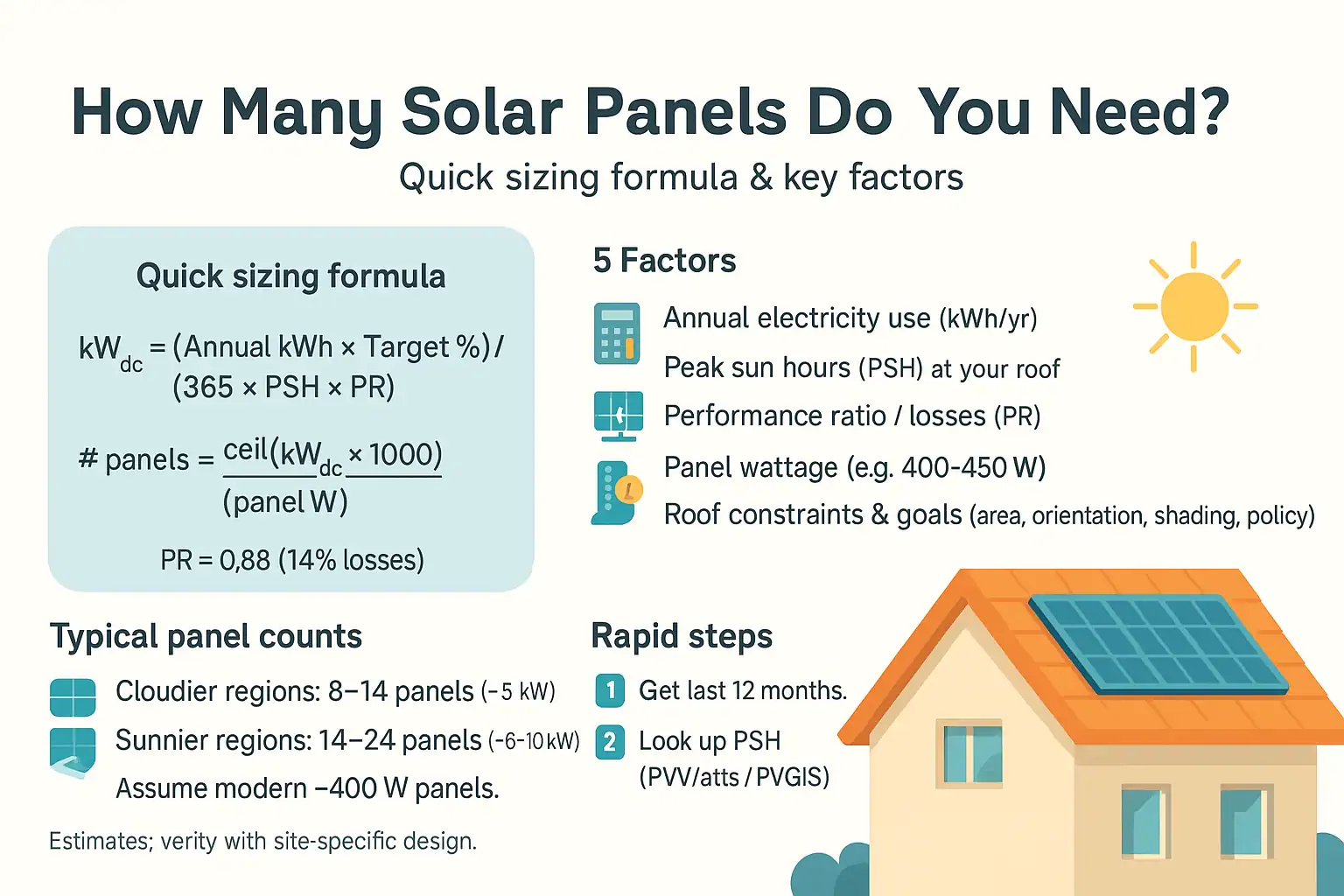
kW_dc = (Annual kWh) / (365 × PSH × PR)
Step 6 — Convert to panel count.
Number of panels = ceil( (kW_dc × 1000) / (panel W) )
NB: ceil means round up to the nearest whole number
Optional — Inverter sizing. Many designs pair a DC array with a slightly smaller AC inverter (DC:AC ~ 1.2). That doesn’t change the panel count you calculated (which is based on DC watts).
Optional — Add a future‑proof margin. If you expect an EV/heat pump or want to account for ~0.5%/yr panel degradation, add 5–15%.
Explore More: Do solar panels work with moonlight?
Worked examples (with 400 W panels and PR = 0.86)
Example A — “Average” U.S. home
- Annual use: 10,500 kWh/yr
- PSH scenarios: 3.5 / 4.0 / 4.5 / 5.0 / 5.5 / 6.0
- Results:
- 3.5 PSH → ~9.6 kWdc ≈ 24 panels
- 4.0 PSH → ~8.4 kWdc ≈ 21 panels
- 4.5 PSH → ~7.6 kWdc ≈ 19 panels
- 5.0 PSH → ~6.8 kWdc ≈ 17 panels
- 5.5 PSH → ~6.4 kWdc ≈ 16 panels
- 6.0 PSH → ~5.6 kWdc ≈ 14 panels
Roof area (4.5 PSH case): 19 panels × 1.9 m² × 1.15 spacing ≈ ~41.5 m² (≈ 447 ft²).
Example B — 2,000 ft² U.S. home (rough‑estimate path)
If you only know square footage, a coarse U.S. rule‑of‑thumb is ~0.5 kWh/ft² per month.
- Estimated annual use: 2,000 × 0.5 × 12 ≈ ~12,000 kWh/yr
- Panel counts:
- 3.5 PSH → ~10.8 kWdc ≈ 27 panels
- 4.0 PSH → ~9.6 kWdc ≈ 24 panels
- 4.5 PSH → ~8.4 kWdc ≈ 21 panels
- 5.0 PSH → ~7.6 kWdc ≈ 19 panels
Accuracy note: Square‑footage based estimates can be off by ±30–50%. Whenever possible, use your actual kWh.
Example C — Typical German single‑family home
- Annual use: choose ~3,600–5,100 kWh/yr depending on household size and whether hot water is electric.
- PSH scenarios (fixed roof): 3.0 / 3.5 / 4.0
- Results (for 4,000 kWh/yr):
- 3.0 PSH → ~4.4 kWdc ≈ 11 panels
- 3.5 PSH → ~4.0 kWdc ≈ 10 panels
- 4.0 PSH → ~3.2 kWdc ≈ 8 panels
Roof area (3.5 PSH case): 10 panels × 1.9 m² × 1.15 ≈ ~21.9 m² (≈ 235 ft²).
What if I use 450 W panels?
Divide the panel counts above by 400/450 ≈ 0.89 (then round up). Example: 19 × 0.89 ≈ 17 panels.
How to measure your peak sun hours (accurately)
- North America: Use NREL PVWatts. Enter your address, roof tilt/azimuth, and “System Losses.” The default losses (~14%) are reasonable for first‑pass design. The calculator returns monthly and annual kWh for any DC size; invert Step 5 to back‑solve kW.
- Europe & worldwide: Use the EU JRC PVGIS tool. Select your roof on the map, choose your technology and tilt, and read off the expected monthly/annual production per kWp.
Tip: If you see seasonally heavy shading (trees, chimneys), consider microinverters/optimizers; they don’t increase total sun but reduce mismatch losses.
Roof space & layout checklist
- Panel area: plan ~1.7–1.9 m² (18–20 ft²) per modern panel plus ~15% for spacing/service paths.
- Best orientations: South‑facing is optimal in the northern hemisphere; SW/W roofs often work well with time‑of‑use rates.
- Tilt: Anything 15°–40° performs fine; flatter roofs need more soiling awareness (minimum ~5°).
- Obstructions: Keep clearance from hips, valleys, vents, chimneys; maintain fire/walk paths per local code.
Cheat sheet
Inputs
- Annual usage (kWh): _______
- Target offset (%): _______
- Peak sun hours (PSH): _______
- Performance ratio (PR): 0.86 (default)
- Panel wattage (W): 400 (or your choice)

Formulas
kWdc = (Annual kWh × Target %) / (365 × PSH × PR)
Number of panels = ceil( kWdc × 1000 / Panel W )
Roof area ≈ No. of panels × 1.9 m² × 1.15
Frequently asked questions
How many panels to “run my whole house”?
Size to cover your annual kWh at your location using the method above. In many places, a 6–10 kWdc system (≈ 15–25 × 400 W panels) offsets a typical detached home’s net annual usage. You still use the grid at night/winter and export during sunny hours unless you add a battery.
Should I oversize for winter?
Usually no. Systems are sized for annual energy, not worst‑month peak. If winter self‑consumption is critical (e.g., off‑grid), you’ll need more panels and storage than most grid‑tied homes.
What about degradation?
Modern modules typically lose ~0.5% of output per year. If you want to maintain today’s offset in year 25, add ~10% capacity now.
What if I’m installing an EV charger or a heat pump?
Add their expected annual kWh:
- EV: ~2,000–3,000 kWh/yr per 10,000–15,000 km (6,000–10,000 miles), depending on efficiency.
- Heat pump: varies widely; your installer can estimate from heating degree days and system COP.
Re‑run Steps 1–6 with the higher total.
Do higher‑efficiency panels reduce the number I need?
Yes—but the governing variable is panel wattage (STC). A 430 W high‑efficiency panel means fewer units than a 370 W panel for the same kWdc. Efficiency mostly matters when roof area is tight.
When to call a pro
DIY math is great for ballpark sizing. Before you buy, have a qualified designer run:
- A shade/irradiance study (lidar or on‑site),
- Stringing & inverter checks (voltage windows, DC:AC ratio),
- Structural review for roof loads and mounting,
- Electrical review for main‑panel interconnection limits (e.g., 120% rule U.S., utility export caps elsewhere),
- A check of policy (net billing, value‑of‑solar, feed‑in tariffs) that affects optimal system size.
Bottom line
- Start with your kWh, not your square footage.
- Use PSH and a 0.86 PR to convert kWh → kWdc.
- Divide by panel watts to get the panel count.
- Expect 8–14 panels in cloudier regions and 14–24 panels in sunnier ones for typical homes using ~400 W modules.