
Do solar panels work with moonlight?
Short answer: Technically, yes. Solar panels can generate a tiny amount of electricity from moonlight—but the output is far too small to be practical.
Why Moonlight Can Generate Electricity
- Moonlight is reflected sunlight, and PV cells are sensitive to the same wavelengths present in sunlight (roughly 400–1100 nm). So, in principle, moonlight can produce a measurable current.
- But the brightness difference is staggering. Illuminance under a full moon is only about 0.05 to 0.1 lux under typical conditions, occasionally reaching up to 0.3 lux for a supermoon at perigee . In direct sunlight, illuminance is around 100,000 lux . That makes moonlight roughly 1 million to 2 million times dimmer than sunlight.
- In real-world terms, this means energy output from solar panels under moonlight is negligible. One article estimates it at just 0.2–0.3% of typical sunlight output—so a 300 W panel might yield only about 1 W in ideal full moon conditions .
How Much Power Can You Actually Get?
Let’s compare:
| Condition | Illuminance (lux) | Relative Brightness to Sunlight |
| Full Moon (typical) | 0.05–0.1 | ~1 × 10⁻⁶ |
| Full Moon (supermoon) | Up to 0.3 | ~3 × 10⁻⁶ |
| Direct Sunlight | ~100 000 | 1 (baseline) |
Even in the best-case scenario, moonlight is millions of times weaker than sunlight—rendering any actual electricity generation from it effectively useless for powering devices.
“But can’t we focus moonlight to boost output?”
Theoretically, you could concentrate moonlight onto a panel using optics—similar to focusing sunlight—but the faintness of the source makes the gain negligible. It simply doesn’t add up to meaningful energy.
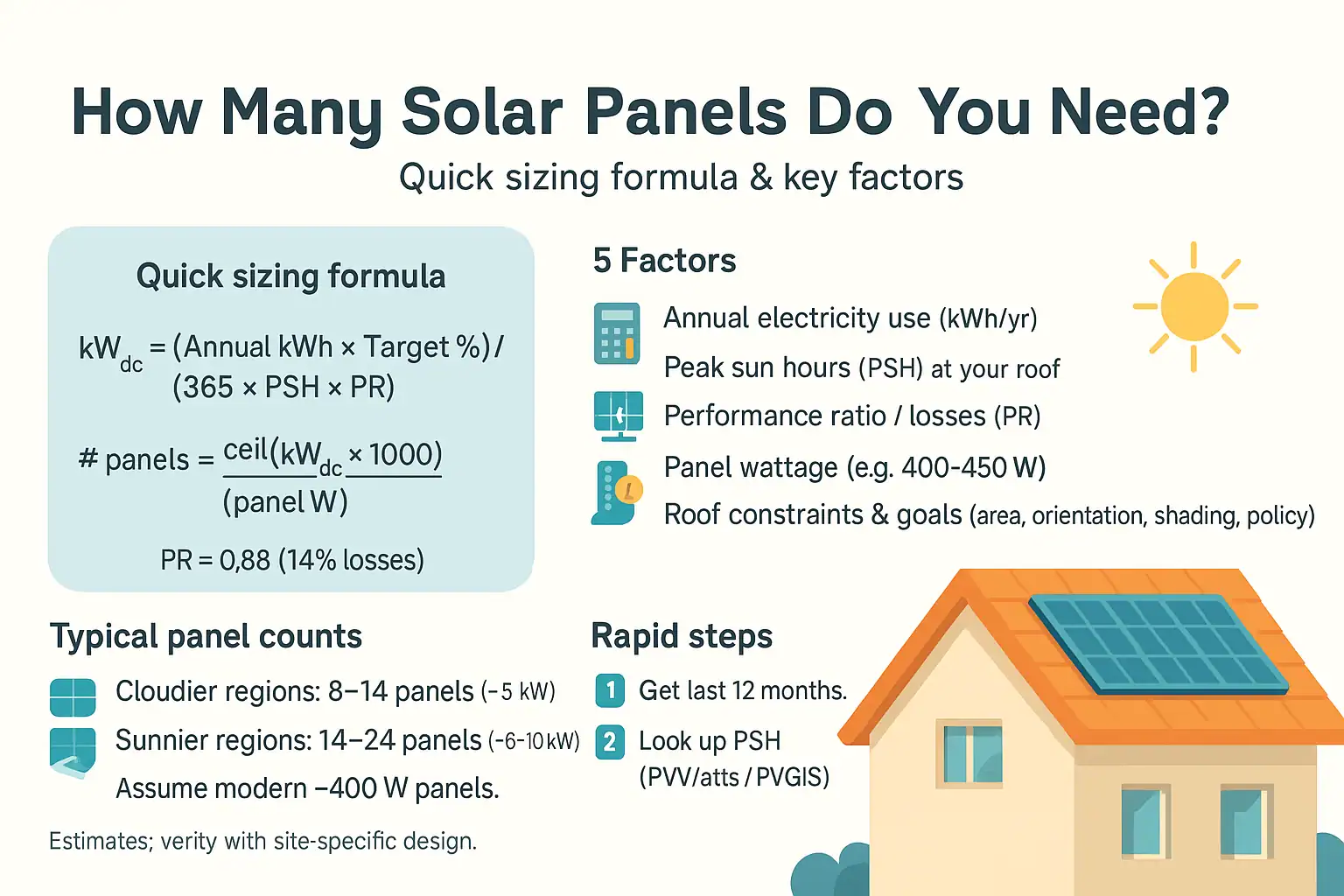
Related Post: How Many Solar Panels Do You Need to Power Your House?
Emerging and Alternative Technologies
Innovative research offers a glimmer of hope—but not via moonlight:
- Thermoradiative generators (a.k.a. “moonlight panels”): A Stanford research team led by Shanhui Fan developed a modified PV setup that captures the heat loss (infrared radiation) from panel surfaces at night, generating about 50 milliwatts per square meter .
For context, a typical solar panel produces around 200 W/m² during the day—so this night-time approach yields about 0.025% of daytime power, which is still tiny but can power ultra-low-energy sensors or LED indicators.
In Summary
Yes, solar panels can produce electricity in moonlight—since moonlight is reflected sunlight and within the photovoltaic response range. But the power generated is inconsequential—on the order of 0.001% to 0.3% of what you’d get from direct sunlight.
- A full moon provides only 0.05–0.3 lux, compared to ~100,000 lux from sunlight .
- In practice, you might get ~1 W from a 300 W panel under full moonlight .
- Modern solar systems also “sleep” at night, and inverters may disable under such low generation .
- True night-time power generation is better achieved via battery storage or net metering, not moonlight.
- Cutting-edge tech like thermoradiative panels may one day offer a practical method to generate small amounts of power at night—but not through moonlight itself .